CLT FIXER
A new website and a Google Ads restart for an appliance repair company in Charlotte. We connected local demand, landing pages, calls and actual sales.
- Year
- 2026
- Market
- Charlotte, North Carolina · USA
- Scope
- Website development, paid search and analytics
- Stack
- WordPress, Elementor, Google Ads and call tracking
Results from the first full month after relaunch. Revenue-to-ad-spend ratios do not account for repair costs or operating expenses.
A local service that had lost confidence in paid search
CLT FIXER repairs refrigerators, washers, dryers, dishwashers, ovens and other household appliances in Charlotte, North Carolina.
Before our involvement, around $7,000 had been spent on Google Ads without creating a predictable flow of inquiries. The issue was not simply poor returns: the client had almost lost trust in the channel.
We needed to rebuild the lead-generation system, review the campaigns, connect analytics and turn a one-page website into a structure that could expand by service, brand and neighborhood.
We started with an audit, not a relaunch
Different needs were all sent to the same generic page: refrigerator repair in Cornelius, an urgent washer repair or service for a particular appliance brand.
Campaigns also mixed services, intent and geography. Budget was spent outside the effective service area and on formats that did not match the immediate need for high-intent leads.
| What was wrong | Why it mattered |
|---|---|
| Broad geography | Inquiries from locations the team could not serve efficiently. |
| Mixed campaign intent | General, service-specific and urgent searches were not clearly separated. |
| Display and YouTube spend | Budget was diverted from people actively looking for a repair. |
| One generic landing page | The search, ad and page did not form a relevant journey. |
| Incomplete measurement | Clicks and form submissions could not be reliably connected to paid jobs. |
One connected lead-generation system
We focused on northern Charlotte and nearby areas the client could consistently serve. Search queries were grouped by appliance, location and urgency.
- DemandA repair need in the service area
- Search adA service- and location-specific message
- Landing pageA relevant offer and clear next step
- InquiryA call or form with a known source
- Paid jobA business outcome, not just a click
We prioritized commercial searches such as “appliance repair near me,” “refrigerator repair,” “washer repair” and “same-day repair.” Searches for buying appliances, parts, DIY instructions and training were excluded with negative keywords.
Smaller geographic segments were grouped to accumulate data faster, while priority areas retained dedicated ads. The historical customer database also provided a first-party audience for retargeting and future campaign learning.
A website rebuilt in about a week and a half
A lengthy development process would have delayed the advertising restart. We used WordPress and Elementor to build a focused, scalable site in approximately a week and a half.
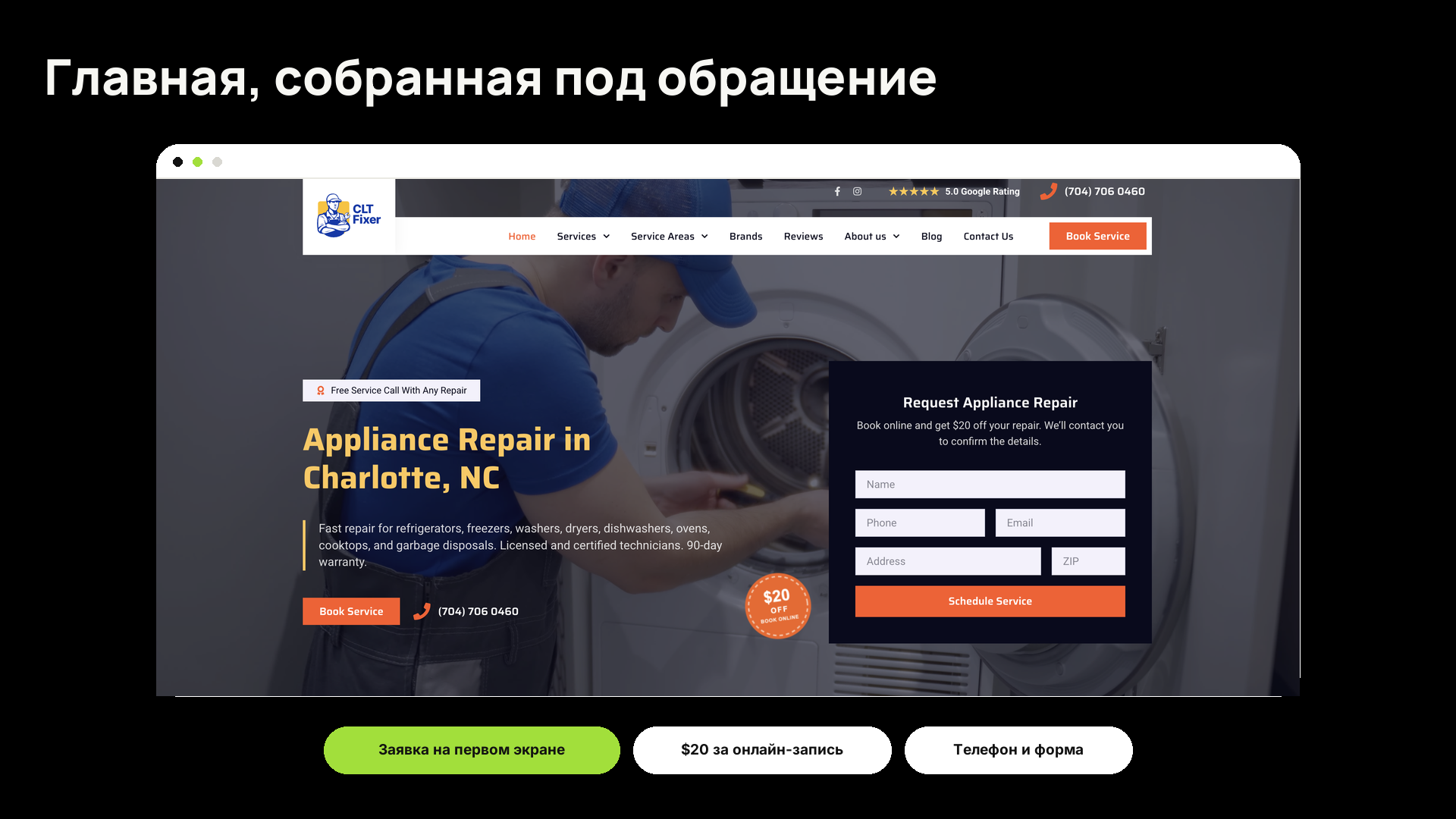
The homepage made the offer clear immediately: appliance repair in Charlotte, a visible phone number, a booking form, a $20 online-booking offer, a quick callback, a 90-day warranty and evidence from the team’s real work.
Reviews, technician information and repeated calls to action helped users decide whether to call, book or explore a specific service.
From one page to a structure that can grow
We created a hierarchy of service, manufacturer and location pages, supported by common appliance problems, reviews, team information and completed work.
A refrigerator-repair query could now lead to a refrigerator-repair page with a relevant headline, typical faults, real photographs, a form and the right call to action.

SEO built into the site, not added afterward
The audit showed why the old landing page could not compete effectively in local search: no dedicated URLs for services, brands or neighborhoods, and headings and metadata that did not reflect demand.
We addressed those issues during development, including page structure, metadata, internal links, structured data, mobile usability and the initial informational content.
Ongoing directory development and backlink work were outside this phase. The site provided the foundation for that next stage.
Connecting ad spend to real sales
We configured Google Tag Manager, Google Analytics and Google Ads conversion tracking, alongside call tracking.
Measurement covered forms, phone clicks, calls, advertising sources, location, query type and subsequent lead qualification. This made it possible to evaluate inquiries against actual paid jobs.
Some inquiries did not convert because of location or because the customer wanted only a service call. Those findings informed the next round of targeting and keyword refinement.
Test the hypothesis. Keep what works.
Search campaigns became the main source of inquiries because they reached people with an immediate repair need.
We also tested Performance Max and Maps placements. They did not deliver the required quality or volume at this stage, so budget was redirected toward Search rather than continuing to fund weak results.
The team used the resulting data to refine search terms and reduce irrelevant traffic.
Creative adapted to local demand
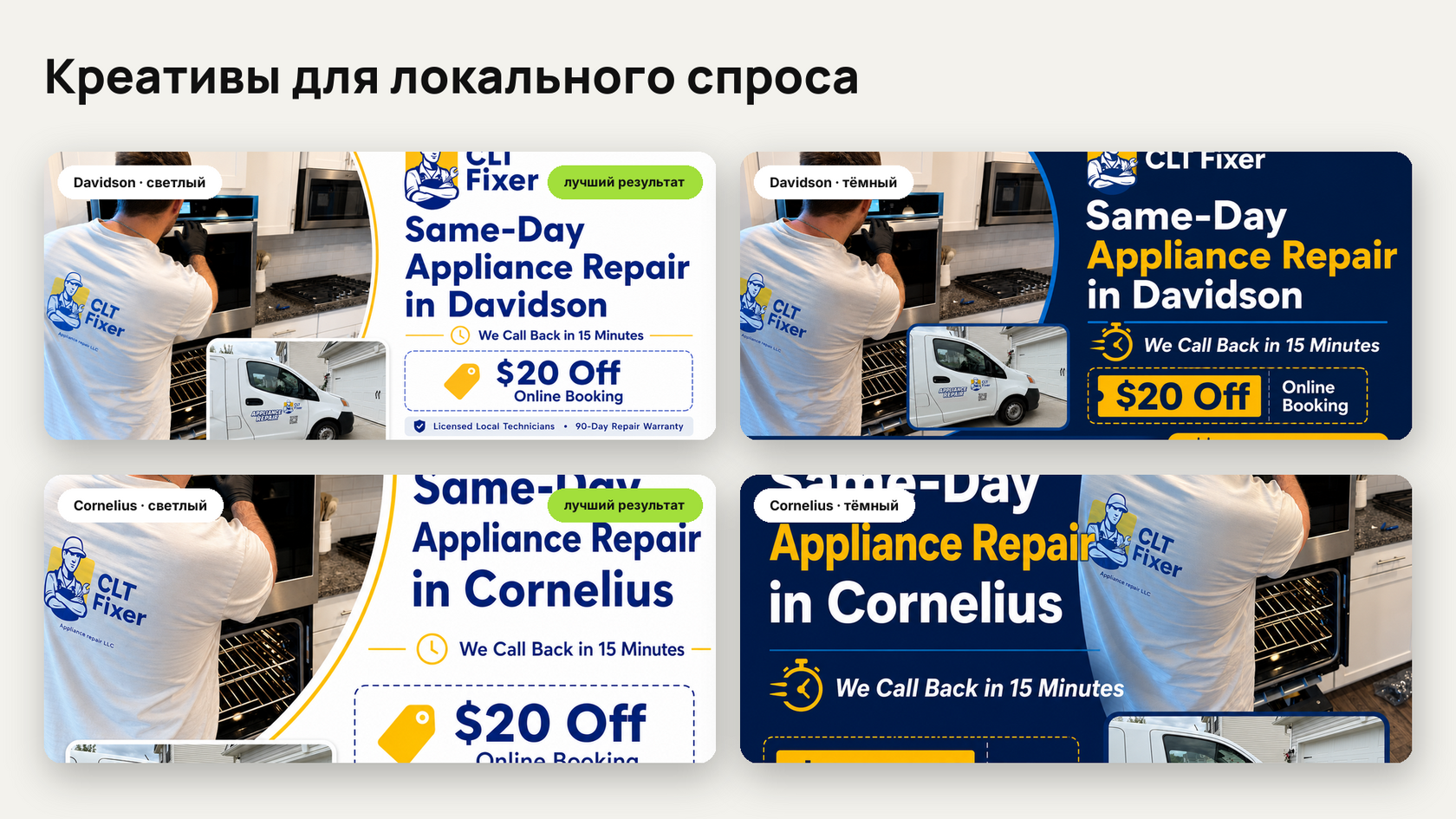
Ads varied by neighborhood, composition and contrast while keeping the core offer consistent: same-day repair, a quick callback, $20 off, local licensed technicians, a 90-day warranty and online booking.
We prepared square and landscape versions. Early tests favored the lighter composition, which became the basis of subsequent launches.
The first full month after relaunch
The initial advertising budget was approximately $2,500. The new structure produced measurable inquiries and paid work.
Up to half of incoming inquiries converted into paid jobs. Figures are approximate where indicated and relate to the first full month, not a guaranteed ongoing benchmark. Revenue-to-ad-spend is not profit or ROI.
More than a successful restart
We restored the client’s confidence in Google Ads by connecting the website, targeting, analytics and actual sales.
The new structure supports more services, manufacturer pages, neighborhoods and local campaigns. It also provides a foundation for organic traffic, retargeting and scaling budget around validated combinations.
CLT FIXER now has a connected lead-generation system rather than a collection of isolated marketing activities.